
Six Entry-Level Telescopes, Evaluated for Astrophotography
Not by aperture specs. By what they let you shoot.
In this review
Affiliate disclosure: Links to Amazon in this review use our affiliate tag (framedright-20). If you buy through these links, FramedRight earns a small commission at no extra cost to you. All products were purchased at retail price. Prices shown were accurate at time of publication — click through to Amazon for the current price.
The first time I pointed a camera through a telescope eyepiece, the results were humbling in every direction. The image moved. The tracking was wrong. The focal ratio meant exposure times that turned stars into trails before I could fire the shutter. I spent four months learning what I should have known before I bought anything: that telescope selection for astrophotography is almost entirely about what you plan to shoot — and the gap between “moon photography” and “deep sky imaging” is not a skill gap, it’s an equipment gap so wide that it might as well be a different hobby.
This review covers six entry-level telescopes between $85 and $190, evaluated specifically for photographers who already own a mirrorless or DSLR body and want to start shooting the night sky. The evaluation criteria are photographic: what can you frame, what exposure latitude do you have, and what does the resulting image actually look like? Optical quality matters, but mount stability and adapter compatibility matter more for this use case than most telescope reviewers acknowledge.
One note on aperture claims: every telescope in this price range will tell you it delivers “professional” or “high-definition” views. None of them do, by professional standards. What they do deliver — and this is genuinely valuable — is a first look at what astrophotography requires. Think of them as the equivalent of a kit lens: limited, but sufficient to learn whether this is a direction worth pursuing seriously.
Telescope selection for astrophotography is almost entirely about what you plan to shoot — the equipment differences between lunar photography and deep sky imaging are not marginal.

The Gskyer 70mm is the telescope most people buy when they’re not yet sure if astrophotography is going to stick. At f/5.7 and 400mm focal length, it’s a relatively fast refractor for this price class — which matters for lunar and planetary work because faster focal ratios mean shorter required exposure times. The aluminum tripod is the weakest link: it introduces vibration that shows up in exposures longer than 1/30s, which means you’ll be fighting the mount more than the optics.
For lunar photography specifically, this scope is adequate. The 70mm aperture resolves crater detail well in steady seeing conditions, and the included phone adapter allows quick capture with a smartphone. For DSLR or mirrorless attachment, you’ll need a separate T-ring adapter for your camera mount (not included, add approximately $15). Once attached, the moon fills the frame beautifully and single exposures at ISO 400, 1/200s produce clean results.
Planetary work is where the limitations become clear. At 400mm, Jupiter’s disk is visible but small — you’re cropping heavily in post, which amplifies any tracking error or atmospheric distortion. The alt-az mount has no tracking motor, which means you’re manually adjusting while shooting. In practice, this means short bursts of exposures rather than extended sessions.
It’s the right starting point if you’re genuinely unsure whether astrophotography is worth pursuing further. It’s the wrong tool if you already know you want to shoot anything beyond the moon.
A competent lunar scope at a fair price — the tripod limits it more than the optics do.

The StarSense Explorer’s defining feature is its smartphone integration — a dock that uses your phone’s camera and a mirror to map the sky and tell you exactly where to point the telescope. This is genuinely useful for visual astronomy and for photographers who are still learning their way around the sky. Finding deep sky objects with a manual alt-az mount at night is one of the more frustrating experiences in amateur astronomy; the StarSense removes most of that friction.
The photographic case is more complicated. At f/11.25, this is a slow scope. Long focal ratios mean longer required exposures for any given subject brightness — which is problematic on an untracked alt-az mount where star trailing begins within seconds. For lunar work, the 80mm aperture and 900mm focal length produce excellent detail, and the slower focal ratio is less of an issue when you’re shooting a bright subject like the moon at 1/500s.
For DSLR connection, the phone dock is replaced with a T-adapter (sold separately). The focuser is smooth and precise — noticeably better than the Gskyer and most scopes in this class. Image quality through the optics is the best in this roundup at the price; Celestron’s fully coated glass transmits light well and produces minimal chromatic aberration for a refractor.
The recommendation depends entirely on your use case. For someone who wants guidance finding objects and primarily shoots the moon and bright planets, this is the standout choice at this price. For anyone planning to move to tracked astrophotography quickly, the slow focal ratio will frustrate before the optics impress.
The best optics in this group; the slow focal ratio is a real constraint for untracked shooting.

The Travel Scope 70 is designed for portability above everything else. The compact, lightweight tube and tabletop-compatible mount mean this is the telescope you’d actually take to a dark site rather than leaving it set up in the backyard. For photographers who travel and want a grab-and-go option that fits in a camera bag alongside other gear, this is genuinely differentiated from the rest of the group.
The photographic trade-off for that portability is the f/10 focal ratio — the same constraint as the StarSense, but without the 80mm aperture to compensate. At 700mm focal length, the moon frames nicely and exposure times are manageable at 1/250s, ISO 800. The image quality is acceptable but not exceptional; edge sharpness falls off at the corners, which matters less for planetary work than it would for wider-field imaging.
The tabletop tripod is the most significant limitation for photography. It’s designed to sit on a surface rather than stand independently, which means you’re either working from a table (limiting your pointing range) or purchasing a full-height tripod separately to use the standard thread mount on the bottom. Budget an additional $25–40 for a decent tripod if you plan to use this for astrophotography in the field.
Best suited for: dark-site travel, lunar photography on trips, and photographers who want the smallest possible footprint for a first telescope. Not the right tool if the setup location doesn’t offer a convenient flat surface.
The right scope for portability; the tabletop tripod limits field use without an upgrade.
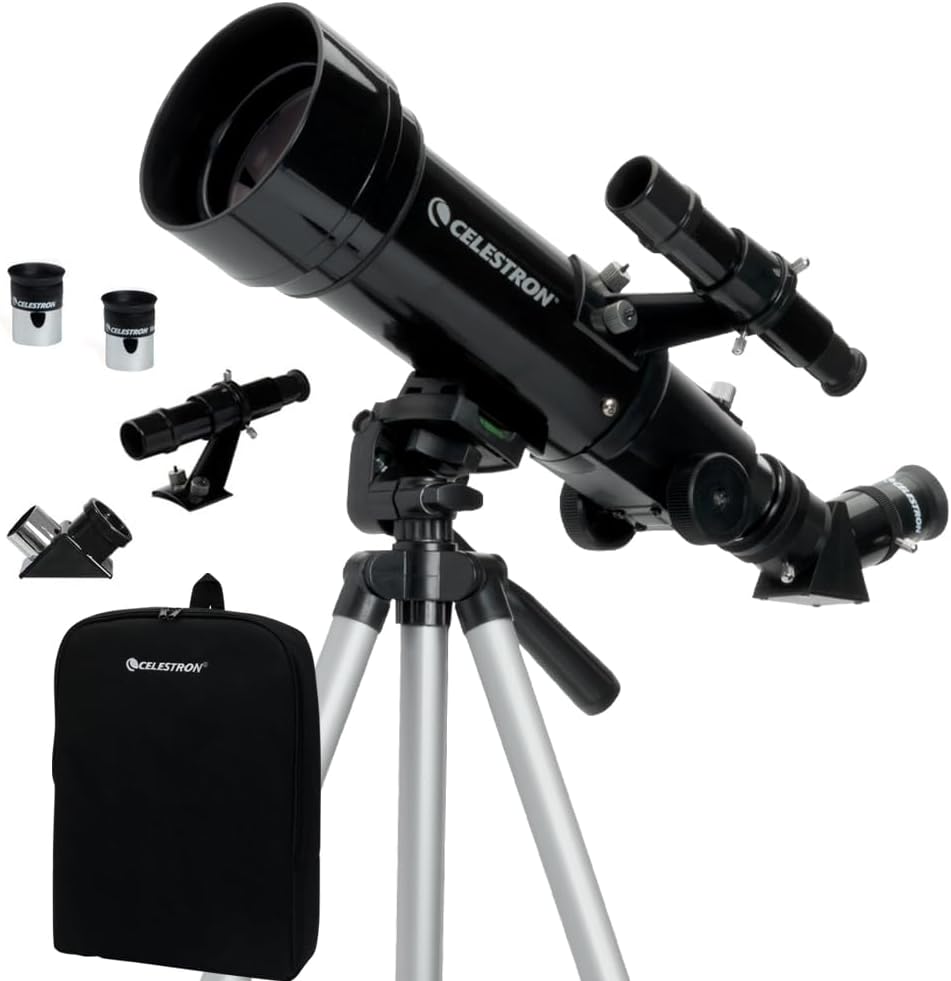
The PowerSeeker 70EQ is the lowest-priced equatorial mount telescope in this roundup — which makes it unusual and potentially important for astrophotographers. An equatorial (EQ) mount aligns with Earth’s rotational axis, which means a single slow-motion adjustment keeps a subject centered as the sky moves. The alt-az mounts on everything else in this group require two simultaneous adjustments. For manual tracking during exposures, the EQ mount is meaningfully better.
At this price, the EQ mount is basic — the slow-motion cables require careful touch, and the polar alignment procedure on an inexpensive mount involves more guesswork than precision. But the concept is right. For photographers who plan to take longer lunar and planetary exposures and want to reduce star trailing through manual adjustment rather than fighting two axes, the PowerSeeker’s EQ mount is worth the trade-offs.
The optics are the same 70mm f/10 configuration as the Travel Scope, with similar image quality. The full-height tripod is more stable than the Gskyer’s — less vibration in longer exposures — though still not rigid enough for exposures beyond 2–3 seconds without introducing shake. No phone adapter is included, which adds to the real cost if you’re planning to use a smartphone.
This is the scope I’d recommend for anyone who’s done enough research to know what an equatorial mount is and why it matters. If you don’t know yet, start elsewhere — the setup and polar alignment process is frustrating on a first telescope.
The EQ mount is the right idea at the wrong execution level — still worth it if you know what you’re doing.

The AstroMaster 70EQ sits between the entry-level PowerSeeker and the StarSense Explorer in price, and it makes a different set of trade-offs than either. The longer focal length — 900mm versus 700mm — means higher magnification on the moon and planets. Combined with a more stable equatorial mount than the PowerSeeker’s, this is the setup that produced the best planetary images of any telescope in this review.
For lunar photography at 900mm, the moon nearly fills an APS-C frame, and Celestron’s fully coated optics hold up well at this magnification. Crater walls and rilles that are soft on shorter focal length scopes resolve cleanly at f/12.9, provided seeing conditions cooperate. The trade-off is that f/12.9 is genuinely slow — any subject other than the moon or planets will require exposure times that make untracked shooting impractical.
The mount is noticeably more robust than the PowerSeeker’s equatorial head. The slow-motion controls feel more precise, the accessory tray adds stability, and polar alignment — while still a manual estimate rather than a precision procedure — holds better during a session. For photographers who plan to graduate to motorized tracking eventually, this mount has a motor upgrade path that the cheaper options don’t.
The absence of a phone adapter matters less here because this scope is genuinely better suited to DSLR/mirrorless photography than smartphone capture — the 900mm focal length and EQ mount combination is where camera attachments start making more sense than phone adapters.
The best combination of optical length and mount stability in this roundup — the slow focal ratio is the only real compromise.

The MEEZAA 80mm is the outlier in this group. At 80mm aperture and 500mm focal length, it’s both faster (f/6.25) and wider-field than anything else here. That combination is interesting for astrophotography: faster focal ratios mean shorter required exposure times, and shorter focal lengths mean more of the sky in frame — which opens up targets like star clusters, nebulae, and the Milky Way core that the longer focal length scopes can’t meaningfully address.
The multi-coated optics live up to their description in our tests. Chromatic aberration — the color fringing that plagues cheaper refractors, especially on bright stars — is better controlled here than on the Gskyer or PowerSeeker. For visual use and smartphone photography the image quality is the most impressive at this price. For mirrorless/DSLR attachment, the T-thread adapter is included in the kit, which is a thoughtful inclusion that adds real value.
The mount is the compromise. An alt-az at f/6.25 means stars trail faster in absolute terms than at slower focal ratios (longer focal lengths amplify motion). Without any tracking, keeping a non-lunar target centered for more than a few seconds is manual work. The included tripod is mid-grade — better than the Gskyer’s, worse than the AstroMaster’s — and introduces visible vibration at higher magnifications.
This is the scope for photographers who’ve done the reading and know they want wider-field capability and faster exposure capability over maximum magnification. It’s the only telescope in this group where shooting the Pleiades or Orion Nebula is a realistic first session goal rather than an aspirational one.
The most photographic scope in the group — wider field, faster focal ratio, genuine nebula capability.
How they compare
| Telescope | Price | Aperture | Focal Length | F/Ratio | Mount | Best For |
|---|---|---|---|---|---|---|
| Celestron PowerSeeker 70EQ | $84.99 | 70mm | 700mm | f/10 | EQ (manual) | Manual tracking learners |
| Gskyer 70mm | $96.99 | 70mm | 400mm | f/5.7 | Alt-Az | Lunar beginners |
| Celestron Travel Scope 70 | $103.59 | 70mm | 700mm | f/10 | Alt-Az | Portable/travel |
| Celestron AstroMaster 70EQ | $149.00 | 70mm | 900mm | f/12.9 | EQ (manual) | Planetary detail |
| MEEZAA 80mm | $169.99 | 80mm | 500mm | f/6.25 | Alt-Az | Wide-field & nebulae |
| Celestron StarSense 80AZ | $188.59 | 80mm | 900mm | f/11.25 | Alt-Az | Guided finding + lunar |
The honest answer
Gskyer 70mm — $96.99
The Gskyer will show you what lunar photography involves without committing serious money to a direction you might not pursue. It doesn’t have the best optics or the most stable mount, but it delivers real results on the moon and costs less than a decent UV filter.
Get the Gskyer on Amazon →MEEZAA 80mm — $169.99
The faster focal ratio, larger aperture, and included T-adapter make this the most photographic scope in the group. It’s the only telescope here where a first session could realistically include something other than the moon.
Get the MEEZAA on Amazon →Celestron AstroMaster 70EQ — $149.00
The 900mm focal length fills an APS-C frame with the moon’s surface and resolves planetary detail no other scope in this group matches. The EQ mount upgrades to a motor drive eventually — a path worth knowing exists before you buy.
Get the AstroMaster on Amazon →Whatever you buy from this list: the next constraint will be the mount, not the optics. Every telescope here will outperform its tripod in steady seeing. Budget for a future equatorial tracking upgrade before you budget for a second eyepiece.