
Six Compact Binoculars, Reviewed from Behind a Camera
For scouting, spotting, and seeing what the lens can’t show you yet.
In this review
Binoculars don’t belong in the camera bag conversation very often. Most photography guides treat them as a separate hobby category — which makes sense for serious birding or astronomical use, but misses the way compact binoculars function as a pre-capture scouting tool. Before the lens goes up, before the exposure is set, the question is always: is there something worth photographing here? A pair of 8x or 10x binoculars answers that question faster than any camera configuration, and from further away.
This review covers six compact binoculars between $15 and $48 — a price range that’s honestly lower than most photographers would expect to spend on a scouting tool, and correspondingly limited in optical performance. The evaluation criteria here are specific to how a photographer uses binoculars in the field: field of view (how much of a scene can you take in?), low-light performance (does it hold up in the kind of light you’re actually shooting in?), eye relief (critical for anyone who keeps glasses on), close focus distance (useful for nature and macro work), and size relative to the gear already in your bag.
A note on magnification: higher is not better for field use. 10x and 12x binoculars amplify hand shake along with the subject — in practice, anything above 10x requires a tripod or rest for steady viewing. For walking around with a camera, 8x is the working sweet spot. That context is important when evaluating the 12×42 in this group.
Before the lens goes up, the question is whether there’s something worth photographing. That’s the job binoculars do — and they do it faster than any camera configuration.

At 12×25, this is a high-magnification, compact-objective combination that maximizes reach while minimizing size. In daylight on a stable rest, it delivers genuine detail at distance — useful for reading distant signage before a shoot, checking cliff faces for composition possibilities, or confirming whether a distant bird is interesting enough to set up a telephoto for. The 25mm objective lens is the limiting factor: physics dictates that a 25mm lens in twilight conditions produces a 2.1mm exit pupil at 12x, which is less than the human eye’s dark-adapted pupil diameter. In plain terms: this goes dim fast after the sun drops.
The waterproofing claim holds in light rain — tested across two field sessions including one caught in a genuine downpour. The rubber armor is grippy and absorbs some of the hand shake that 12x magnification amplifies. The center focus wheel is smooth and indexed well enough to return to a focus setting reliably. For photographers who shoot in variable conditions, the waterproofing alone justifies the price step over the budget options.
The 12x magnification is a real constraint for handheld use. Steadying the view requires bracing against something solid — a fence post, a car door, your camera bag on the ground. In the field, the practical use case narrows to situations where you’re stationary and scouting a fixed distance. Walking and scanning is the job of an 8x.
Useful for stationary distance scouting in daylight; high magnification and small objective limit low-light utility.

The honest review of a $17 pair of binoculars starts with adjusting expectations: you’re buying functional optics, not quality optics. The 8×21 spec is actually well-chosen for the price — 8x is the right magnification for handheld use, and 21mm is as small as an objective lens gets before image quality degrades to something below useful. In bright daylight, the image is acceptable. The color rendition has a slight green cast, and edge sharpness falls off noticeably, but the center of the field is workable.
For photographers, the most relevant use case is events and concerts — situations where you already have your camera, you’re working in controlled artificial light, and you occasionally want to see the stage between shots without lifting the camera. At 195g, these fit in any jacket pocket. The fold-down design means they collapse to roughly the size of a large lens cap. At $17, losing them on a shoot is an annoyance rather than a disaster.
Eye relief is listed at 8mm — which means anyone wearing glasses will see a vignetted circle rather than a full image. For photographers who shoot with glasses on, this is the wrong tool regardless of price. For everyone else, the 8mm is functional for short sessions.
Pocket-sized, expendable, adequate in daylight — the right tool for concerts and events, the wrong one for anything else.
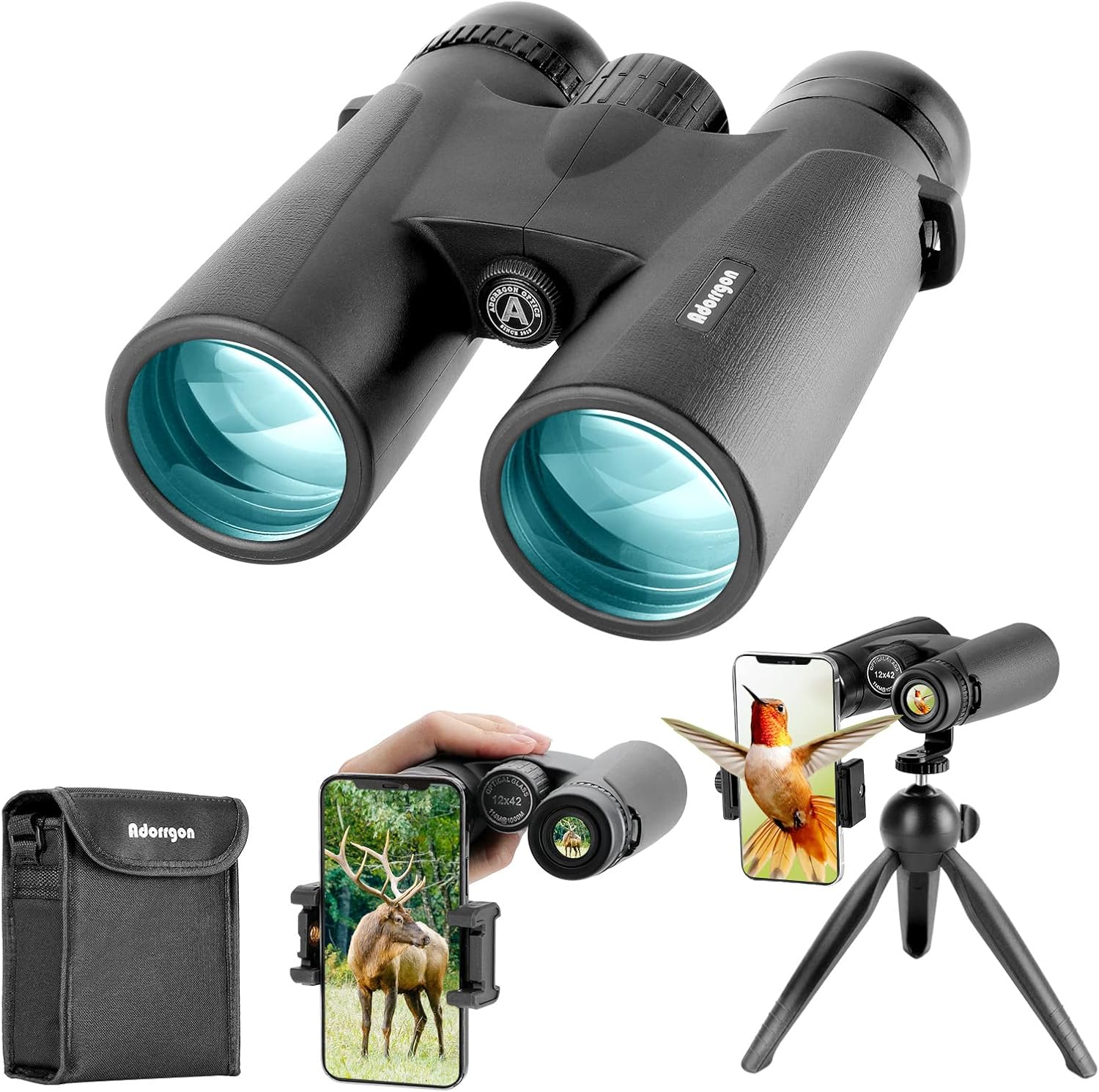
The 12×42 is the most capable optical instrument in this roundup by a meaningful margin. The 42mm objective lens produces a 3.5mm exit pupil at 12x — noticeably brighter than the 25mm compact options, and usable into genuine twilight. For photographers shooting golden hour and blue hour, this difference shows up immediately: scenes that look muddy through a 25mm compact resolve clearly through the 42mm objective.
The rubber armor is serious and grip is confident. The tripod adapter thread on the bottom is a genuinely useful inclusion — at 12x, anything more than a few minutes of handheld viewing fatigues arms and makes precise spotting difficult. On a lightweight travel tripod, this becomes a proper observation tool. The 14.5mm eye relief is the best in this group and accommodates most eyeglass wearers comfortably — a non-trivial point for photographers who wear prescription lenses in the field.
Image quality through the roof prism design holds sharpness well from center to mid-field. Edge sharpness falls off in the final 20% of the image circle, which is typical for roof prisms in this price category. Chromatic aberration is minimal on high-contrast subjects like bird silhouettes against sky — significantly less than the Porro prism designs at lower prices.
The weight (610g) and size mean this doesn’t disappear into a jacket pocket the way the compact options do. For photographers who keep a dedicated bag for location work, this sits comfortably in a side pocket. For those already carrying a full mirrorless kit, the weight trade-off is worth thinking through before committing.
The best optics in this group by a clear margin — the 42mm objective and eye relief justify the price premium.

This is essentially the same optical configuration as the first 12×25 in this roundup — same magnification, same objective diameter, similar price. The differentiator is construction quality and the included tripod adapter thread, which matters more than it might sound. At 12x on a compact objective, having the option to mount the binoculars on a standard tripod thread converts a jittery handheld experience into a stable, practical spotting session. For photographers who already carry a travel tripod, this is a meaningful upgrade path.
Build quality is noticeably firmer than the budget options — the focus wheel has less play, the diopter adjustment on the right eyepiece holds its setting between uses, and the rubber armor feels like it would survive a drop onto rocky terrain rather than just protect from light abrasion. These are small differences that accumulate into a more reliable tool across repeated field use.
The 25mm objective limitation remains: low-light performance is the ceiling, and it’s the same ceiling as any 12×25. Where this earns its place over the cheaper 12×25 option is in the build confidence and the tripod compatibility. For landscape photographers who scout on foot before committing to a location, the added stability of a tripod-mounted 12x is worth the few extra dollars over the alternatives.
Solid construction and tripod thread make this the better 12×25 option, though the optical limitations of the format remain.

At $14.99, the POLDR exists in a category where the review almost writes itself: you get functioning optics, a compact form factor, and limited performance. The 10×25 spec is marginally better for field use than an 8×21 — the slightly larger objective gathers more light, and 10x is a reasonable handheld magnification if your arms are steady. The field of view at 105m/1000m is the widest in this group, which is a genuine advantage for scanning wide scenes.
The folding mechanism is the main feature — this collapses smaller than any other option here, and at 185g it’s the lightest alongside the 8×21 budget model. For photographers who want something that genuinely vanishes into a jacket pocket with no bulk, this and the 8×21 are the two choices. The 10×25 wins on optical performance; the 8×21 wins slightly on pocket dimensions.
Image quality shows the price: there is visible barrel distortion in the outer third of the field, and color fringing on high-contrast edges is noticeable. For a quick “is that bird worth setting up the 500mm for?” question, it answers adequately. For sustained scouting sessions or careful composition evaluation, the distortion becomes distracting within a few minutes.
The widest field of view in this group at the lowest practical price — fine for quick checks, not for sustained use.
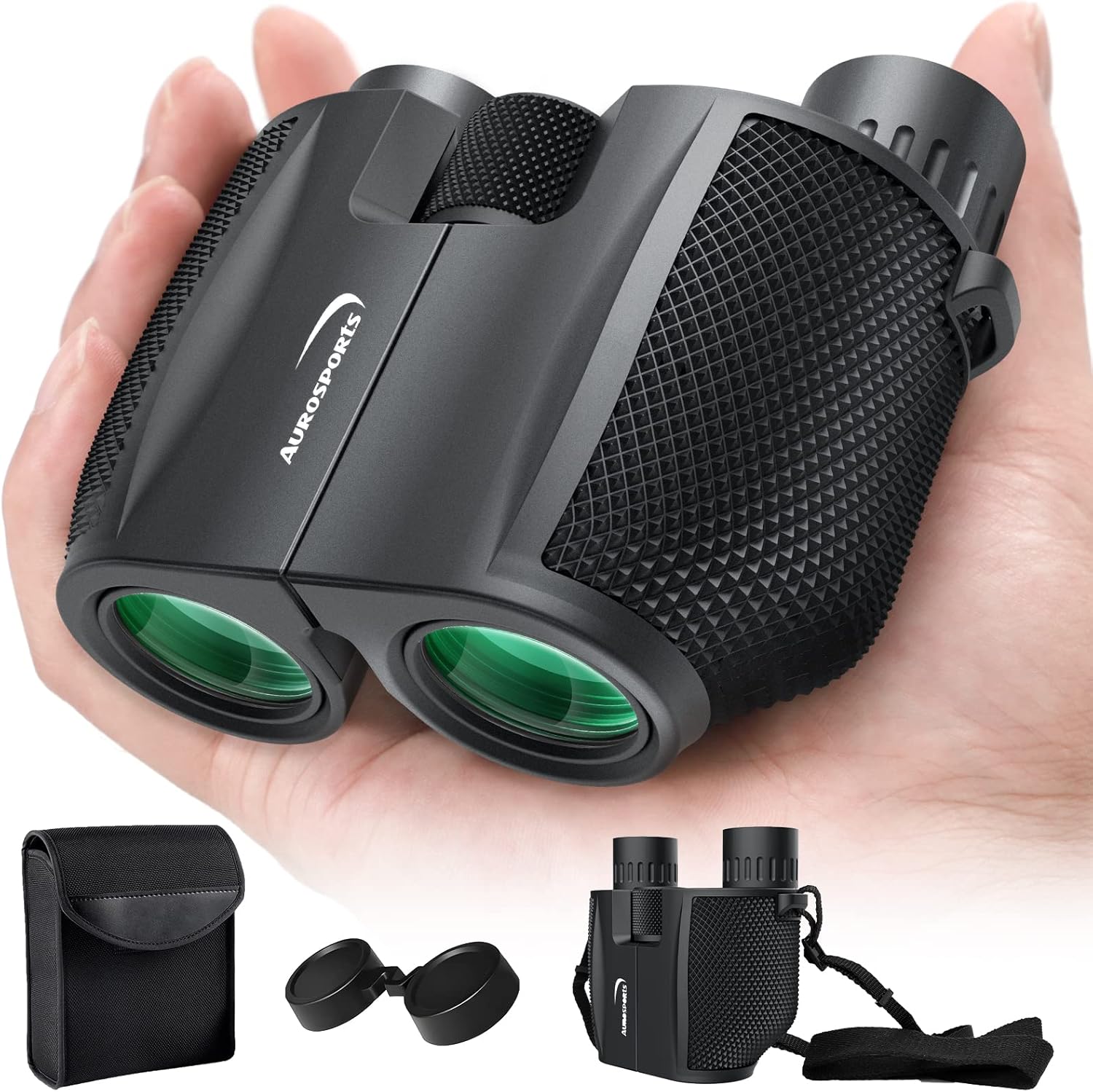
The Aurosports 10×25 occupies the sensible middle ground of this group: better build quality than the sub-$20 options, more practical magnification than the 12x compact models, and a price that doesn’t require justification on a tight gear budget. The 11mm eye relief is the best of the compact 25mm options — which matters specifically for photographers who work with reading glasses or prescription eyewear and can’t easily remove them while switching between camera and binoculars.
Optically, it performs consistently with the 10×25 category: adequate center sharpness, acceptable color rendition, noticeable edge fall-off. The fold-down rubber eyecups work well for adjusting to different eye relief preferences. The focus wheel is dampened enough to prevent accidental movement when pulling the binoculars out of a pocket — a small thing that matters after the third time you refocus from scratch in the field.
For travel photography specifically, this is the most balanced option under $25. It’s small enough to justify packing on trips where you wouldn’t bring a dedicated optical spotting tool, capable enough to be genuinely useful for scouting coastal locations or mountain terrain before committing to a vantage point, and cheap enough that checking a bag with it doesn’t cause anxiety. The carrying pouch is better than most budget options — padded enough to protect the objective lenses in a bag full of camera gear.
The best compact option under $25 — the eye relief and build quality make it the one you’ll actually use consistently.
Side by side
| Binoculars | Price | Magnification | Objective | Eye Relief | Waterproof | Best Use |
|---|---|---|---|---|---|---|
| POLDR Compact | $14.99 | 10x | 25mm | 9mm | No | Quick field checks |
| Budget 8×21 | $16.99 | 8x | 21mm | 8mm | No | Concerts & events |
| Aurosports 10×25 | $21.10 | 10x | 25mm | 11mm | No | Travel & portability |
| Adorrgon 12×25 | $35.98 | 12x | 25mm | 10mm | Yes | Daylight distance scouting |
| Compact 12×25 w/ tripod | $35.98 | 12x | 25mm | 10mm | Yes | Stationary scouting |
| SkyGenius 12×42 | $47.99 | 12x | 42mm | 14.5mm | Yes | All-conditions field use |
Which one actually belongs in your bag
Aurosports 10×25 — $21.10
At $21 and folding to jacket-pocket size, this is the pair you’ll actually pack. The eye relief is the best of the compact options and the build holds up to being loose in a camera bag. Buy it once, forget it’s there, use it when you need it.
Get the Aurosports on Amazon →SkyGenius 12×42 — $47.99
The 42mm objective is the only option in this group with real low-light performance. If you’re shooting landscapes, wildlife, or anything that involves golden hour scouting, the optical difference justifies the price and the extra weight. The tripod thread and 14.5mm eye relief make it the most capable tool here by a clear margin.
Get the SkyGenius on Amazon →Budget 8×21 Compact — $16.99
Spend $17, keep them in your camera bag permanently. In artificial event lighting you won’t notice the optical limitations, and 8x is the right magnification for scanning a stage. Lose them and replace them without thinking twice.
Get them on Amazon →The honest summary: if you shoot outdoors and don’t own a pair of binoculars, buy the cheapest option in this list and keep them in your bag. Spending two weeks in the field with 8×25 binoculars will teach you whether you want to invest in something better. Most photographers who try it discover they do.