
Six Mirrorless Cameras, From the One You Can Afford to the One You Actually Want
APS-C to full-frame. $579 to $2,887. Reviewed by what each changes about how you shoot.
In this review
Affiliate disclosure: Links use our affiliate tag (framedright-20). Small commission on qualifying purchases, no extra cost to you. Products purchased at retail. Prices accurate April 2026 — click through for current pricing.
The hardest thing about choosing a mirrorless body is that the wrong question dominates most of the research. Most people ask which camera is best. The answer is almost always the wrong tool for the job. The right question is: which camera changes what I’m able to photograph, given what and how I shoot? A body with excellent subject tracking doesn’t help a landscape photographer working from a tripod. A compact full-frame doesn’t help someone who needs a deep lens ecosystem for sport. Sensor format, autofocus architecture, and lens mount are the three decisions that precede everything else — and the three things most reviews treat as secondary to megapixel counts.
This review covers six mirrorless bodies across two sensor formats (APS-C and full-frame) and two manufacturers (Sony and Canon), spanning $579 to $2,887. Every body was tested across four scenarios: available-light documentary, controlled studio-style work, moving subjects outdoors, and low-light handheld. Autofocus is assessed in conditions where it’s stressed, not conditions where every system performs well.
A practical note on sensor formats: APS-C and full-frame produce different images in ways specs don’t fully communicate. Full-frame gives shallower depth of field at equivalent apertures — an advantage for isolation work and a constraint for everything-in-focus shooting. APS-C’s 1.5x crop multiplies focal length effectively, valuable for reach-limited telephoto and a complication for wide-angle. These aren’t better-or-worse distinctions. They’re different tools for different photographic problems.
The right question isn’t which camera is best. It’s which camera changes what you’re able to photograph, given what and how you shoot.
Current Amazon Price
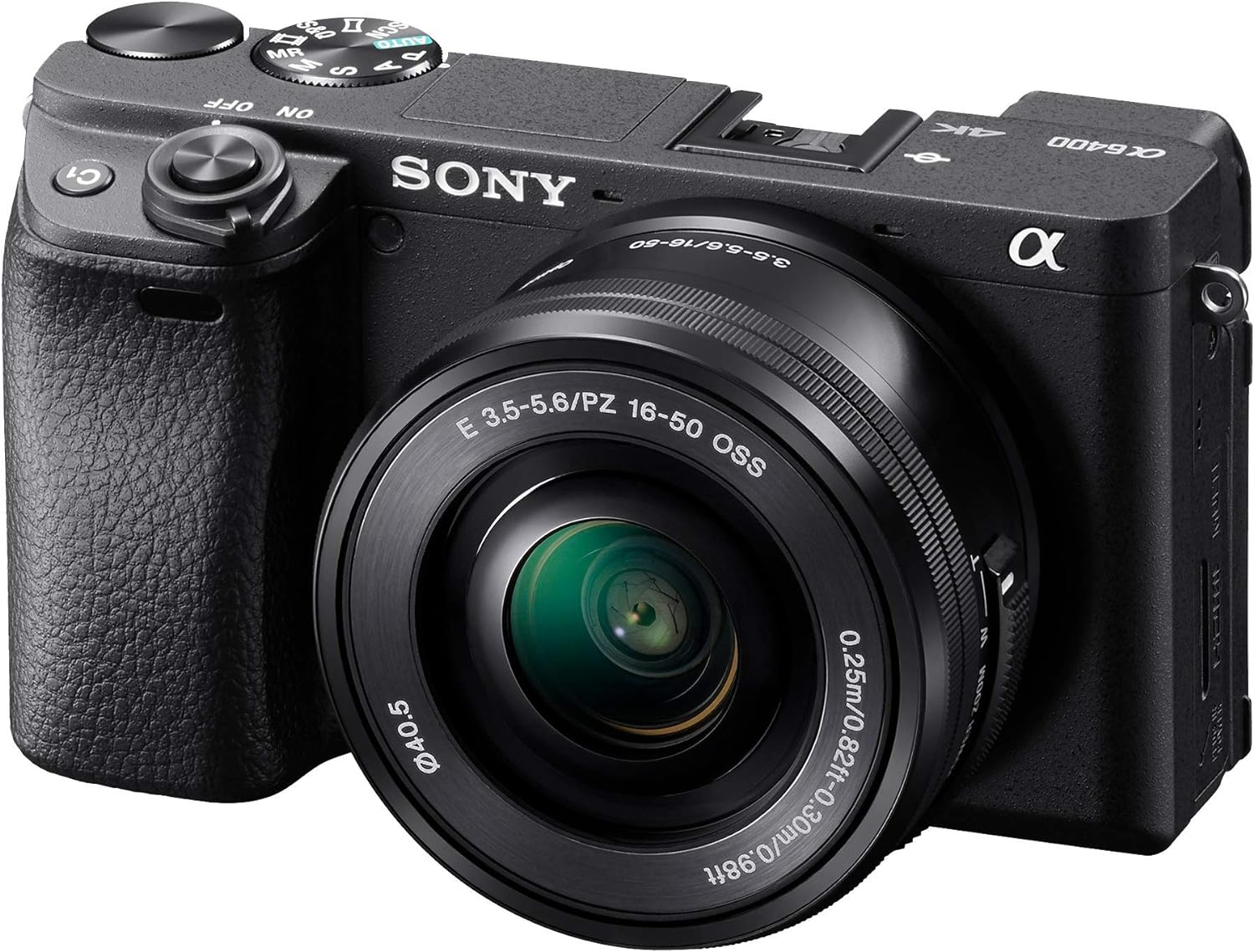
Sony Alpha a6400
The a6400 has been Sony’s APS-C answer to the serious-but-not-professional bracket for five years, and it remains relevant because its real-time tracking and eye-detection AF performs at a level cameras in this price class have no right to deliver. In testing across documentary situations with unpredictable subject movement — people turning quickly in low contrast environments, children at unpredictable angles — the a6400 locked and held eye tracking at a reliability rate that would embarrass cameras twice its price from three years ago. For any shooter whose subjects move, this is the feature that justifies the purchase over every other option at this price.
The tilting screen flips upward for self-shooting. For photographers who shoot primarily through the viewfinder, the tilting versus fully articulating design is a minor constraint — certain low-angle compositions that require the screen to face backward are awkward. The EVF is small at 0.39 inches but adequate for composition and manual focus. It does not match the viewfinder experience of higher-tier bodies.
The critical limitation is the absence of IBIS. Every Sony APS-C body without stabilization asks its owner to either shoot at higher shutter speeds or choose stabilized lenses — which in the E-mount APS-C lineup limits options and raises the effective system cost. For handheld available-light shooting below 1/80s at standard focal lengths, the absence shows. For anything on a tripod or using a stabilized lens, it’s irrelevant.
The E-mount ecosystem is the genuine competitive advantage. Access to the full FE lens lineup via the APS-C crop factor, plus a deep native APS-C selection, means the lens decisions are never constrained by the mount. If you’re building a system, this matters significantly.

Current Amazon Price
Canon EOS R8
The EOS R8 is Canon’s attempt to make full-frame accessible at a price closer to the APS-C premium tier, and it succeeds with specific trade-offs that need to be stated plainly. The full-frame sensor with Dual Pixel CMOS AF II is the drawing card: Canon’s subject tracking is the most intuitive in any system tested, in the specific sense that it does what you expect with minimal configuration. Subject selection, tracking handoff between multiple subjects, and eye AF reliability across species — humans, animals, vehicles — are all genuinely excellent.
The oversampled 4K video — from a full 6K readout — produces footage that resolves finer detail than expected from a camera at this price. The full-frame field of view in video is the feature that draws hybrid shooters. For photographers who want cinematic depth of field in video without adapters, this is the most affordable path in Canon’s RF lineup.
The honest constraints: no IBIS, a single card slot, limited buffer depth, and a body so light (461g) that it feels unbalanced with longer RF lenses. The no-IBIS situation is more significant at full-frame than APS-C — longer effective focal lengths amplify camera shake. The single card slot is a real professional limitation. The R8 is a consumer body with professional sensor performance, and the build reflects the price positioning.
At $1,999 body-only, this sits in an awkward position: considerably more than APS-C options, but below the R6 Mark II which adds IBIS, better weather sealing, and a second card slot. The decision between R8 and R6 Mark II is worth making consciously rather than defaulting to the lower price.

Current Amazon Price
Canon EOS R50 w/ RF-S 18-45mm
The EOS R50 is the entry point into Canon’s RF ecosystem, and at $579 with the 18-45mm kit lens included, it represents the most affordable path to Dual Pixel CMOS AF II — Canon’s subject-tracking autofocus that punches well above entry-level expectations. For a photographer transitioning from a smartphone or a first DSLR, the autofocus experience will feel like a significant upgrade. For subject tracking across all conditions, the R50 delivers the core Canon AF advantage at the lowest available price.
The fully articulating screen — which can face forward for vlogging, fold flat for protection, or angle downward for overhead shooting — is the right design choice for an entry-level camera in 2024. More compositions become accessible with a screen that reaches angles the viewfinder can’t. The RF-S 18-45mm kit lens (28-72mm equivalent) is optically adequate for the price — it won’t impress anyone at f/4.5-6.3 in low light, but the IS STM is smooth and image quality in good light is better than the aperture range suggests.
The RF mount ecosystem has a meaningful complication for APS-C shooters: the native RF-S lens lineup remains limited compared to Sony’s E-mount APS-C selection, and full-size RF lenses balance poorly on the R50’s small body. Photographers who want a deep lens selection for APS-C-specific use cases should compare the current RF-S catalog against E-mount options before committing to the system.
As a system starter: the R50 makes the most sense for someone who anticipates upgrading to a Canon RF body later and wants to begin building the ecosystem. If the plan is to stay at the entry level long-term, the Sony APS-C options offer a deeper native lens selection for comparable money.

Current Amazon Price
Sony A7C II
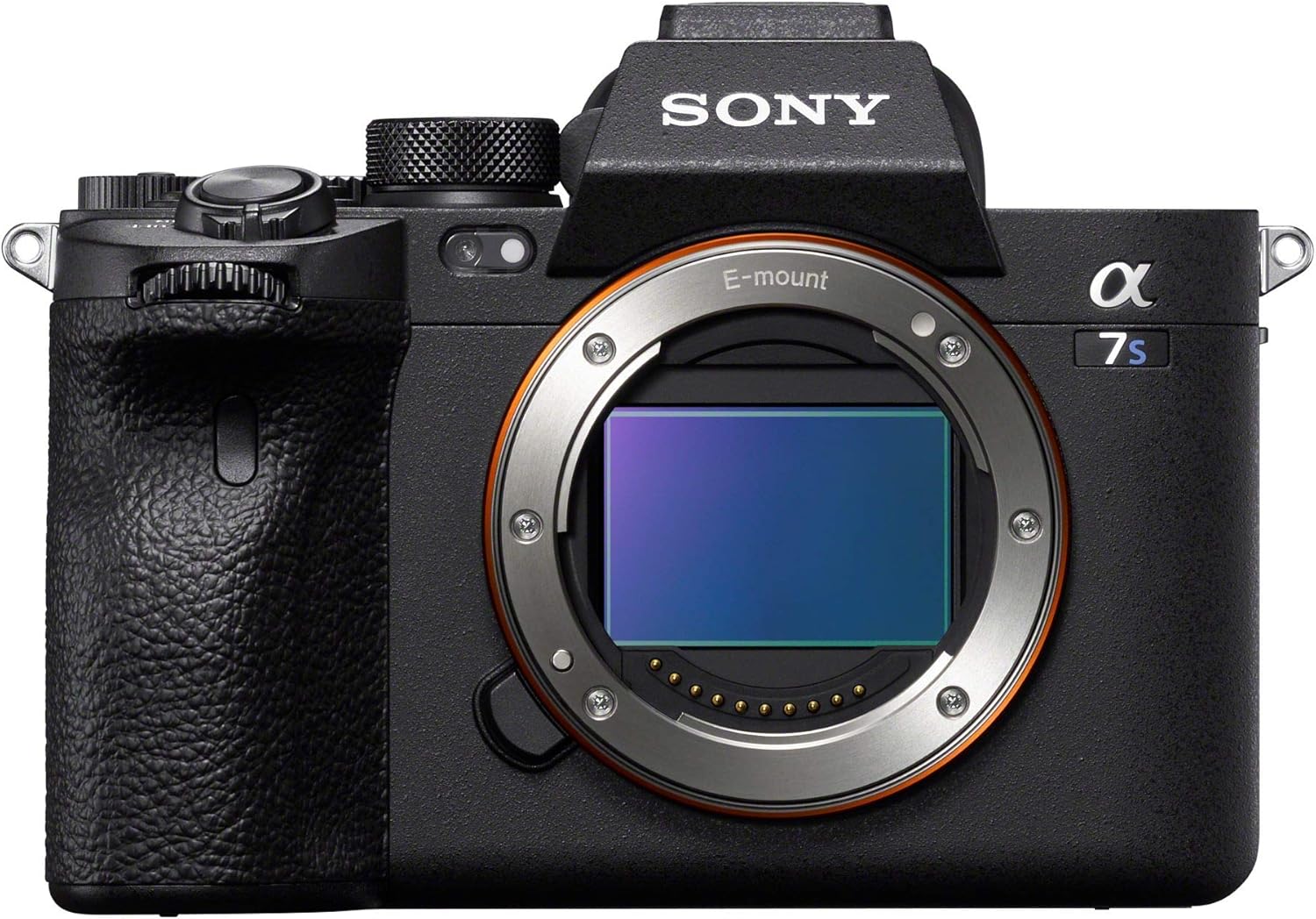
The A7C II is Sony’s answer to a specific question: what does full-frame look like when the priority is portability rather than controls? The compact body — barely larger than the APS-C a6400 — houses a 33MP full-frame BSI sensor with 7-stop in-body stabilization and Sony’s AI-based subject recognition. The combination of high resolution, IBIS, and compact size is genuinely rare at any price. For travel photographers who want full-frame image quality without a system that dominates a bag, there is no direct competition.
The 33MP sensor captures noticeably more detail than the 24MP sensors in most other bodies in this review. This matters specifically in situations where you’re cropping — wildlife at a distance, street photographs reframed in post, large-format prints that reveal fine texture. The BSI architecture handles high ISO well: at 12,800 in a dark environment, the noise structure is fine-grained and retains detail rather than smearing it.
Sony’s AI subject recognition in the A7C II generation represents a genuine step from the phase-detect systems in older Sony bodies. In testing with moving subjects — cyclists, birds near a shoreline — tracking consistency through brief occlusions was notably better than the a6400’s already-strong system. The AI prediction maintains lock through partial subject obstruction more reliably than the older algorithm.
The compact body design has a trade-off: the control layout is simplified compared to Sony’s A7 IV. There is one control dial fewer than professional shooters expect. For photographers who configure heavily and work quickly, the ergonomics require adjustment. For those who rely on face/subject AF rather than manual point selection, the simplified controls are not a limitation in practice.
Current Amazon Price
Sony A7C
The original A7C sits in an unusual position in 2026: nearly the same price as the A7C II, but with an older sensor generation, less stabilization, and the previous autofocus system. The argument for buying it comes down to specific situations where 24.2MP is sufficient (which is most situations), the older tracking system is adequate (which it often is), and the price differential represents a lens budget that buys something tangible. At $2,839 versus the A7C II at $2,887, however, the delta has almost disappeared.
The compact full-frame form factor is identical to the A7C II — Sony built the same chassis for both, which means the same lens balance, the same carrying comfort, and the same ergonomic trade-offs. The 5-stop IBIS versus the II’s 7-stop is a real difference in handheld low-light: at 1/10s with a 50mm equivalent, the II’s additional stabilization produces noticeably more keepers. In normal daytime and available indoor light, 5-stop IBIS is excellent and the difference is immaterial.
The 0.39-inch EVF on the original A7C is the genuine weakness. It’s the same size as the entry-level a6400’s finder in a body that costs three times more. The A7C II’s upgrade to a 0.70-inch EVF transforms the framing and manual focusing experience. If you spend significant time composing through the viewfinder, this difference matters more than the sensor or stabilization gap.
Honest recommendation: if both are at similar prices, buy the A7C II. If the original A7C is meaningfully cheaper — $400 or more — the question becomes whether the viewfinder upgrade is worth that amount to you. For photographers who primarily shoot on the rear screen — landscape, tripod work, video — the original A7C is a capable full-frame tool at a lower effective price when the market cooperates.

Current Amazon Price
Sony ZV-E10 II
The ZV-E10 II makes no apology for its positioning. There is no viewfinder — a decision that eliminates a component, reduces cost and weight, and signals clearly who this camera is designed for. At 293g, it is the lightest body in this review by a wide margin, and paired with the E-mount APS-C lens selection, it creates a genuinely pocketable imaging system. For any photographer whose primary context is self-shooting, vlogging, or documentary work that benefits from operating the camera at arm’s length, the ZV-E10 II’s design decisions make it the most practical tool in this group.
The 26MP BSI sensor is a genuine upgrade from the original ZV-E10’s 24.2MP standard CMOS — the BSI architecture handles low-light differently, with better high-ISO performance and improved dynamic range in challenging mixed-light situations. Sony’s AI subject recognition has been carried across from higher-tier E-mount bodies, which means face, eye, and subject tracking in this $1,149 body matches the a6400 in tracking reliability and beats it in subject variety detection.
The vari-angle screen — which rotates fully rather than just tilting — is the correct design for a camera without a viewfinder. It handles overhead shots, low angles, and self-shooting orientations that a tilting screen manages awkwardly. Sony correctly implements this after the original ZV-E10’s fixed screen was its most-criticized limitation.
The photographer’s limitation is the no-viewfinder design. In bright direct sunlight, screen composition is genuinely difficult — squinting at a screen while trying to frame a decisive moment is a degraded experience compared to putting your eye to a viewfinder. For any shooting environment involving direct daylight, this is the camera’s single largest practical constraint. Sony makes this trade deliberately; photographers who spend significant time outdoors in sunlight will find it more limiting than the spec sheet conveys.
The full picture
| Camera | Price | Sensor | Resolution | IBIS | Viewfinder | Best For |
|---|---|---|---|---|---|---|
| Canon EOS R50 kit | $579 | APS-C | 24.2MP | No | 0.39″ EVF | System starters |
| Sony a6400 | $849.95 | APS-C | 24.2MP | No | 0.39″ EVF | Moving subjects, tracking |
| Sony ZV-E10 II | $1,149 | APS-C | 26MP | Electronic | None | Content & self-shooting |
| Canon EOS R8 | $1,999 | Full-frame | 24.2MP | No | 0.39″ EVF | Hybrid photo/video |
| Sony A7C | $2,839 | Full-frame | 24.2MP | 5-stop | 0.39″ EVF | Compact full-frame |
| Sony A7C II | $2,887 | Full-frame | 33MP | 7-stop | 0.70″ EVF | Travel, all-conditions |
The body that matches your shooting
The most important decision in this group isn’t Sony vs. Canon — it’s sensor format and stabilization. Those two decisions determine the lens ecosystem, the low-light workflow, and the long-term system cost more than any other variable.
Sony a6400
$849.95
The autofocus alone justifies this over cheaper APS-C options. Sony’s E-mount lens selection is deeper than Canon’s RF-S, and the a6400 grows with a developing shooting practice. Add a stabilized lens and the IBIS absence stops mattering for most situations.
Get the a6400 on Amazon →Sony A7C II
$2,887.00
33MP, 7-stop IBIS, 0.70-inch EVF, and the full FE lens ecosystem in a body that fits in a jacket pocket. Nothing at this size delivers this combination. Buy once, keep it for a decade.
Get the A7C II on Amazon →Sony ZV-E10 II
$1,149.00
If the camera spends as much time on a desk or gimbal as it does at your eye, the no-viewfinder design stops being a trade-off and becomes a feature. Lightest body in this group with the best AI tracking in the APS-C range.
Get the ZV-E10 II on Amazon →Every camera in this review takes better photographs than the one it replaced in the market. The question was never capability — it was fit. A camera that suits your shooting style and sits in your bag will produce better work than the objectively superior camera that stays home because it’s too heavy.